


The Ford GT40: America's Racing Hero
- Anthony Morrison

- Sep 6, 2024
- 4 min read

Ford. A name that carries history, legacy, and tradition unlike any other in American history. Since the dawn of the automobile Ford has been there from the start but like many other manufactures, it wasn't always sunshine and rainbows. In the 1960's Ford was at the brink of losing it all.
Nearly six decades after Henry Ford opened the factory doors, the Blue Oval brand struggled to put butts in seats of their road cars, losing out to General Motors in sales for nearly the whole decade. Add to the fact that a deal with Enzo Ferrari went sour to really add salt to Fords wounds. Ford was in a pickle. Pressure from higher ups would lead to the creation of a diamond on four wheels. An innovative chain of events would see Ford taking all of its resources to the last place you would expect when your reputation is being dragged through the mud. Ford would go racing with a factory backed team with hopes to restore their glory to the brand's name. The GT40 would be the conduit that would cement the Blue Oval brand back to the top spot.
Before the Glory
Like a late night college essay, the GT40 started as a last minute attempt. It's not completely the companies fault. Ford was between a rock and a hard place during the GT40's development.
The Detroit based automaker found itself being decimated in the sales department. The culprit would come in the form of General Motors branded mid-sized sedans. In 1968, GM would go on to sell 1.24 million vehicles compared to Ford 495,000. I don’t need a whiteboard and Expo marker to tell you that GM definitely had a leg up in the showrooms. To remedy the sales disasters, Ford would go back to the drawing board and create their own market with the release of the new, fresh, and exciting Mustang. How would they sell it? Racing of course. The American sports car would be subject to the “win on Sunday, sale on Monday” mantra. The Sunday contender would be the GT40.

Building an Icon
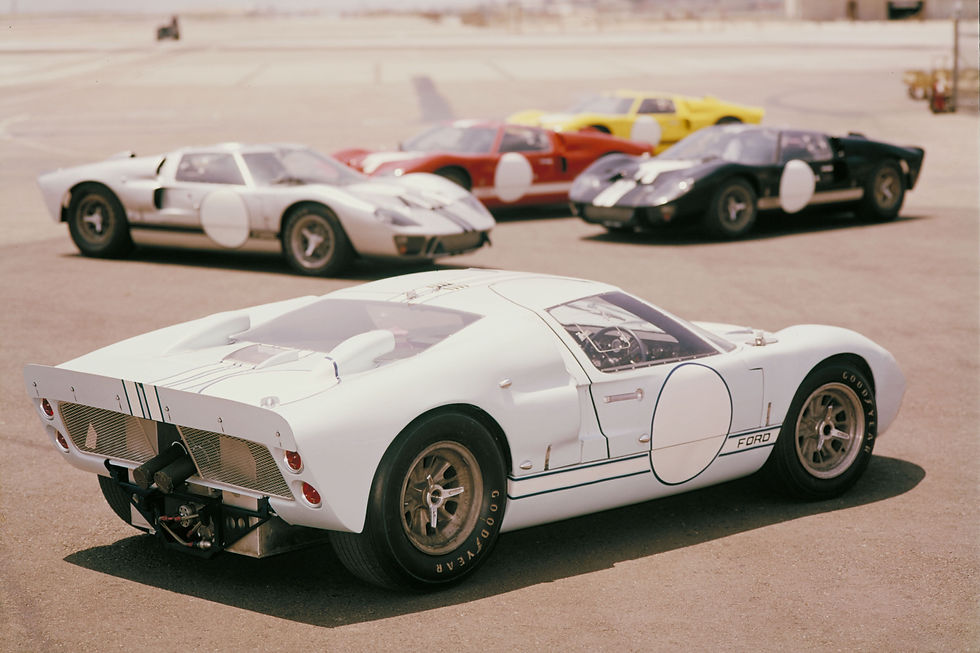
Every inch of the GT40 (40, being the number of inches the cars chassis is from the ground) was built for racing. The chassis was designed by Eric Broadley, Chief Engineer and Founder of Lola Cars. The British engineer used his racing experience to create a chassis capable of handling the GT40’s larger-than-life powertrain whilst maintaining lightness and agility. After an initial 10 months and a few failed attempts at the win, the result was a mid-engine Ford with a NASCAR 8 cylinder that boasted 7.0 liters of displacement that weighed in at only 1835 Lbs. With 485 horsepower on tap the GT40 propelled to speeds that the world had never seen. But to reach these speeds the GT40 would need a long stretch of road.
Luckily, the GT40 was built for the 24 Hours of Le Mans, a race that is home to a 3.7 mile (6 kilometer) stretch of road, also known as, the Mulsanne Straight. The Circuit de La Sarthe in France would be the stage where the GT40 would be put to the test. Early attempts at the trophy in 64' and 65' would find Ford falling short of the crown. Mechanical issues would sent the American racing team packing home early. The growing pains would pay off though. Ford took first, second, and third in the 1966 race against seasoned manufacturers Porsche, Alpine, and most notably, Ferrari. The GT40’s victory in France solidified not only Ford’s but America’s presence in global motorsports.

Lasting Legacy
Prior to Ford’s victory at Le Man 66’, not many American manufactured vehicles went racing overseas, let alone take victory at those events. Aside from Duesenberg's victory in the 1920 French Grand Prix, there wouldn’t be an another American victory overseas as significant as the GT40's win in '66.

Even though the Duesenberg was the first to take victory, Ford would take victory in a much more spectacular fashion. Much like the recent Centenary edition of Le Mans, the Henricks Motorsport's Garage 56 NASCAR reminded people what Detroit muscle and American engineering could do. It turns out being unbelievably loud and lightning fast in the straights is a great way to leave a mark. Run the clock back about 6 decades and the GT40 did the exact same thing. If speed and bleeding ears weren't enough, the famous one, two, three photo finish is would send shockwaves throughout the automotive history books and solidify Ford as the American motorsports heroes.
Many American racecars have come and gone but none are as iconic as Ford’s Le Mans prototype. The GT40 may not the first to take the top step on foreign soil but is perhaps the most iconic American racecar and is a testament to all things American motorsports. Naming an American racecar before it is difficult but identifying a fire breathing bald eagle machine after Ford's victory is easy. The win raised the bar for U.S. manufactures and put a spotlight on American sportscar racing internationally, which would push manufactures to produce some of the greatest racecars and road cars for generations to come. The GT40 would become America's first racing icon, all inspired by General Motors sedans and a business deal gone wrong.


Comments